United States Mileage Reimbursement Rate (IRS 2026)
Current Benchmark Rate
$0.725 / mile (2026 IRS Standard)
Federal: FLSA minimum-wage floor; Mandatory by state law in CA, IL, MA, DC & others
In the United States, the 2026 IRS standard business mileage rate is $0.725 per mile. Reimbursements paid at or below the IRS rate under an accountable plan are tax-free to employees and deductible for employers. While federal law does not mandate mileage reimbursement unless driving costs push pay below minimum wage, states including California, Illinois, Massachusetts and DC require private employers to reimburse necessary business driving and work expenses.
Total Reimbursement
$181.25
Total Distance
250 miles
Effective Rate
$0.725/mi
United States Mileage Reimbursement Rate Breakdown
| Category / Vehicle | Primary / Tier 1 | Tier 2 / Cap | Notes |
|---|---|---|---|
| Business driving (2026 IRS) | $0.725 / mile | No annual cap | Applies to gas, diesel, hybrid and electric personal vehicles. |
| FAVR (Fixed + Variable) | Monthly fixed stipend | Variable cents / mile | Popular for field reps driving 5,000+ business miles/year. |
Worked United States Payroll Example
Scenario: A field technician drives 320 business miles between job sites in one biweekly pay period.
Calculation: 320 miles × $0.725/mile = $232.00 tax-free reimbursement.
Reimbursement Payout: $232.00
Tax & Payroll Rules (IRS)
- Payments at or below $0.725/mile under an IRS accountable plan are excluded from W-2 wages and payroll taxes (FICA/FUTA).
- Reimbursements above the IRS rate are taxable wages on the excess portion unless substantiated under a compliant FAVR (Fixed and Variable Rate) program.
- Ordinary commuting between home and a regular workplace is personal travel and not eligible for tax-free reimbursement.
Logbook & Audit Requirements
- Date of each business trip and total business miles driven.
- Start and destination locations (or client/job site) plus business purpose.
- Contemporaneous submission within the employer's accountable-plan window (commonly 30–60 days).
US State-by-State Mileage & Expense Laws
Explore mandatory private-employer reimbursement statutes and state travel rates:
Automate United States mileage & expenses in ClockIt
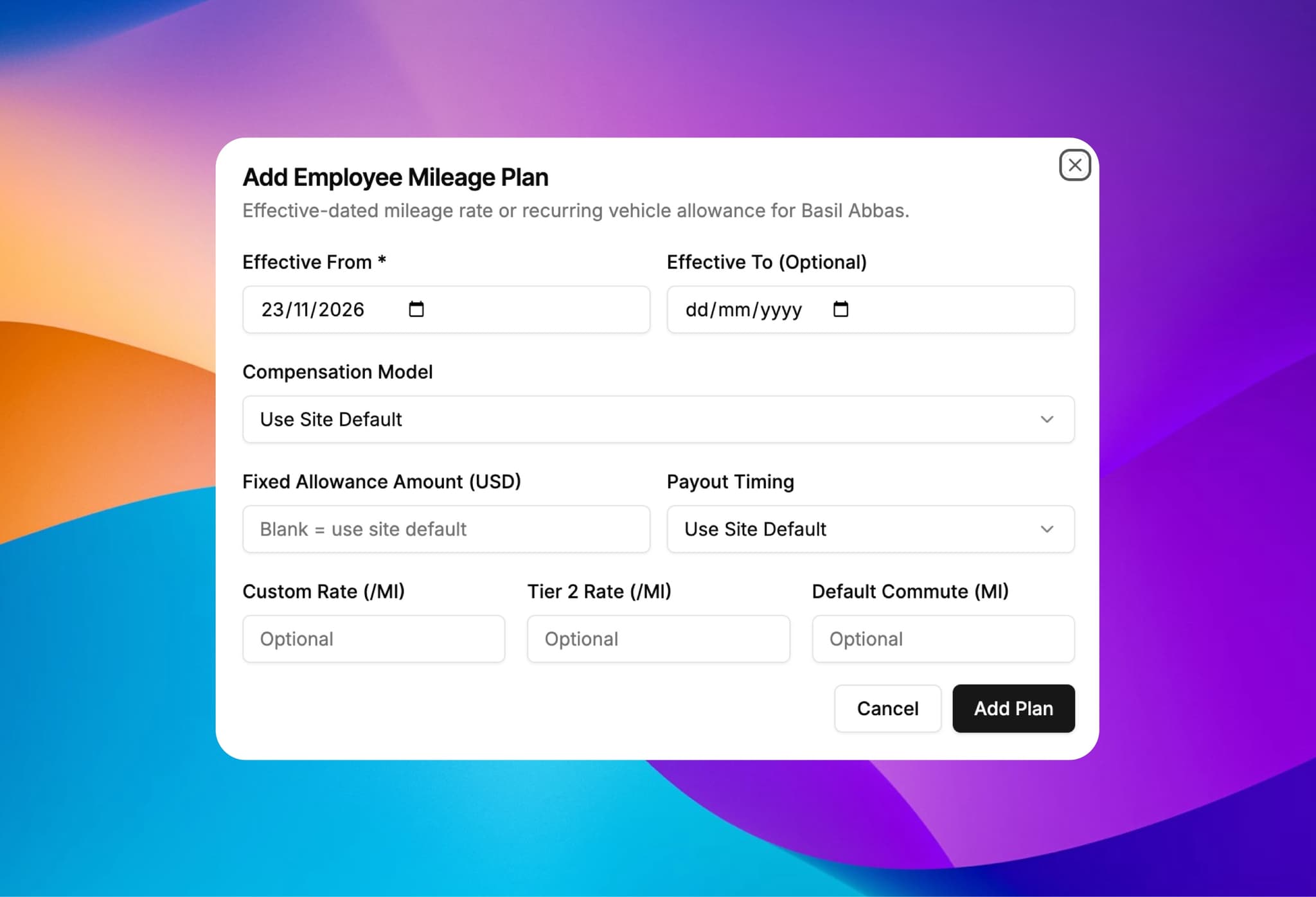
Set your United States site to miles in USD with automatic January 1 tier resets, multiple vehicle rates and receipt caps. Employees log trips on mobile, web or kiosk, and approved payouts flow directly into Payroll Run.
What is the 2026 US IRS mileage reimbursement rate?
The 2026 IRS standard business mileage rate is $0.725 per mile (72.5 cents), covering fuel, depreciation, insurance and maintenance.
Are US employers legally required to pay the IRS mileage rate?
Federally, the FLSA only requires reimbursement if vehicle costs drop an employee's effective wage below federal minimum wage. However, states like California (Labor Code § 2802) and Illinois (820 ILCS 115/9.5) legally require private employers to reimburse necessary driving expenses, and using the IRS rate is the safest compliance benchmark.
Is mileage reimbursement taxable in the US?
No, provided it is paid at or below the IRS standard rate (or under a valid FAVR plan) with documented dates, mileage and business purpose under an accountable plan.
Can employers pay a flat monthly car allowance instead of per-mile?
Yes, but an unsubstantiated flat car allowance is treated as taxable W-2 income subject to payroll taxes. Pairing a fixed allowance with variable mileage under a FAVR plan or reimbursing verified per-mile logs avoids unnecessary payroll tax.