Global Payroll & Reimbursement Hub • 2026 Rates
Mileage & Expense Reimbursement Rates by Country & US State
Look up statutory business mileage rates, annual tier thresholds, tax-free rules, and mandatory private-employer expense statutes — then calculate payouts instantly or automate reimbursements inside ClockIt Payroll Run.
2026 IRS standard business mileage rate ($0.725/mile).
Total Reimbursement
$181.25
Total Distance
250 miles
Effective Rate
$0.725/mi
Mileage Reimbursement Guides by Country (12 Jurisdictions)
United States
IRS$0.725 / mile (2026 IRS Standard)
Federal: FLSA minimum-wage floor; Mandatory by state law in CA, IL, MA, DC & others
United Kingdom
HMRC45p / mile (first 10,000 mi) · 25p thereafter
Tax-free HMRC Approved Mileage Allowance Payments (AMAP)
Australia
ATOA$0.88 / km (ATO Cents-per-km)
Modern Awards often mandate vehicle allowances; ATO rate sets tax-free benchmark
Canada
CRACA$0.72 / km (first 5,000 km) · CA$0.66 thereafter
CRA reasonable per-km allowance is tax-exempt when based solely on distance
Ireland
Revenue€0.4180 – €0.9001 / km (Civil Service Engine & Distance Bands)
Tax-free up to Revenue Civil Service motor travel rates; ERR reporting applies
New Zealand
IRDNZ$1.04 / km (Tier 1 up to 14,000 km) · Tier 2 by fuel type
Tax-free employer reimbursement up to IRD kilometre rates
Germany
BMF€0.30 / km (Car Dienstreise) · €0.20 / km (Motorcycle)
Tax-free travel expense reimbursement (Reisekosten / Kilometerpauschale)
France
URSSAF€0.529 – €0.697 / km (URSSAF Barème by Fiscal HP & km)
Exempt from URSSAF social charges within official Barème Kilométrique limits
Spain
AEAT€0.26 / km (IRPF Tax-Exempt Limit)
Tax-exempt up to €0.26/km plus documented tolls and parking
Singapore
IRASCompany Policy (Typically S$0.50 – S$0.80 / km)
IRAS exempts actual business mileage reimbursements; fixed allowances are taxable
South Africa
SARSR4.76 / km (SARS Prescribed Simplified Rate)
Tax-free on payroll when reimbursed at or below SARS prescribed rate
United Arab Emirates
MOHRE / Company PolicyAED 1.00 – 2.00 / km (Corporate Benchmark)
Governed by employment contract & company policy; 0% personal income tax
US State Mileage & Expense Reimbursement Laws
Federal law (FLSA) sets a minimum-wage floor, but states including California, Illinois, Massachusetts, D.C., Iowa, Montana, New Hampshire, North Dakota and South Dakota impose explicit private-employer reimbursement statutes. Select a state below for its statute, rate and pre-filled calculator.
California (CA)
Mandatory LawCalifornia Labor Code § 2802
California strictly requires all private employers to indemnify employees for all necessary business expenditures, including work-related personal vehicle mileage, cell phone usage, and remote-work expenses. Paying the 2026 IRS rate ($0.725/mile) is the recognized safe-harbor benchmark unless an employee proves higher actual costs.
Illinois (IL)
Mandatory LawIllinois Wage Payment & Collection Act (820 ILCS 115/9.5)
Illinois requires private employers to reimburse employees for all necessary expenditures or losses incurred within the scope of employment and directly related to services performed for the employer — including business mileage and work expenses.
Massachusetts (MA)
Mandatory LawM.G.L. c. 149 § 148 & 454 CMR 27.04(4)
Massachusetts requires employers to reimburse employees for transportation expenses when an employee is required to report to a location other than their regular work site or travel between work sites during the day, and prohibits shifting business expenses onto workers in violation of the Wage Act.
New York (NY)
Mandatory LawNY Labor Law § 198-c & 12 NYCRR § 142-2.10
New York enforces promised reimbursement policies as legally binding wage supplements under Labor Law § 198-c, and strictly prohibits unreimbursed driving or tool expenses from reducing an employee's pay below New York's higher state/NYC minimum wage (closely enforced for delivery and field staff).
Texas (TX)
FLSA / IRSFLSA 29 CFR § 531.35 & Texas Comptroller Travel Rate
Texas does not have a state statute mandating private-employer mileage reimbursement, so federal FLSA rules apply: employers must reimburse driving costs whenever unreimbursed mileage would push an hourly employee's net pay below minimum wage. Most Texas employers adopt the 2026 IRS rate ($0.725/mile) to stay tax-free and competitive.
Florida (FL)
FLSA / IRSFLSA 29 CFR § 531.35 & Fla. Stat. § 112.061 (Public)
Florida does not mandate private-employer mileage reimbursement by state statute, but Florida's rising state minimum wage makes FLSA anti-kickback compliance critical for delivery drivers, home-care aides and hourly field staff. Private employers widely use the 2026 IRS rate ($0.725/mile).
District of Columbia (DC)
Mandatory LawD.C. Mun. Regs. tit. 7, § 910
Washington, D.C. requires employers to pay the cost of purchasing and maintaining required tools, uniforms, and business travel expenses — including mileage — whenever employees are required to travel on company business.
Iowa (IA)
Mandatory LawIowa Code § 91A.3(6)
Under the Iowa Wage Payment Collection Law (Iowa Code § 91A.3), any business expenses — including mileage — that are authorized by the employer and incurred by the employee must be reimbursed within 30 days of submitting an expense claim.
Montana (MT)
Mandatory LawMont. Code Ann. § 39-2-701
Montana law requires employers to indemnify employees for all that the employee necessarily expends or loses in direct consequence of discharging their job duties — including business mileage and work expenses.
New Hampshire (NH)
Mandatory LawN.H. Rev. Stat. Ann. § 275:57
New Hampshire requires employers to reimburse employees for any expenses incurred in connection with employment (other than normal commuting) within 30 days after the employee submits proof of the expense.
North Dakota (ND)
Mandatory LawN.D. Cent. Code § 34-02-01
North Dakota requires employers to indemnify employees for all necessary expenditures or losses incurred in direct consequence of discharging their job duties, including required business driving.
South Dakota (SD)
Mandatory LawS.D. Codified Laws § 60-2-1
South Dakota law requires employers to indemnify employees for all that the employee necessarily expends or loses in direct consequence of discharging their duties — covering business mileage and necessary work expenses.
Washington (WA)
FLSA / IRSFLSA / RCW 49.46 & Seattle App-Based Worker Rules
Washington does not have a general private-employer mileage mandate statewide, but Washington's high state minimum wage (and Seattle's even higher local minimum wage) makes reimbursing hourly drivers and field staff essential to prevent unlawful wage kickbacks. State agencies follow the 2026 IRS rate ($0.725/mile).
Pennsylvania (PA)
FLSA / IRSPA Wage Payment & Collection Law (43 P.S. § 260.1) & FLSA
Pennsylvania does not require private employers to reimburse mileage by statute unless driving costs drop an employee below minimum wage — however, once promised in an employee handbook or contract, reimbursements are enforceable under the Pennsylvania Wage Payment and Collection Law.
Colorado (CO)
FLSA / IRSColorado COMPS Order & C.R.S. § 24-9-104 (Public)
Colorado does not mandate private-employer mileage reimbursement statewide, but Colorado's high state/Denver minimum wage and strict COMPS Order overtime rules (12-hour daily / 40-hour weekly) make proper mileage reimbursement critical for hourly field workers. Private employers standardly pay the 2026 IRS rate ($0.725/mile).
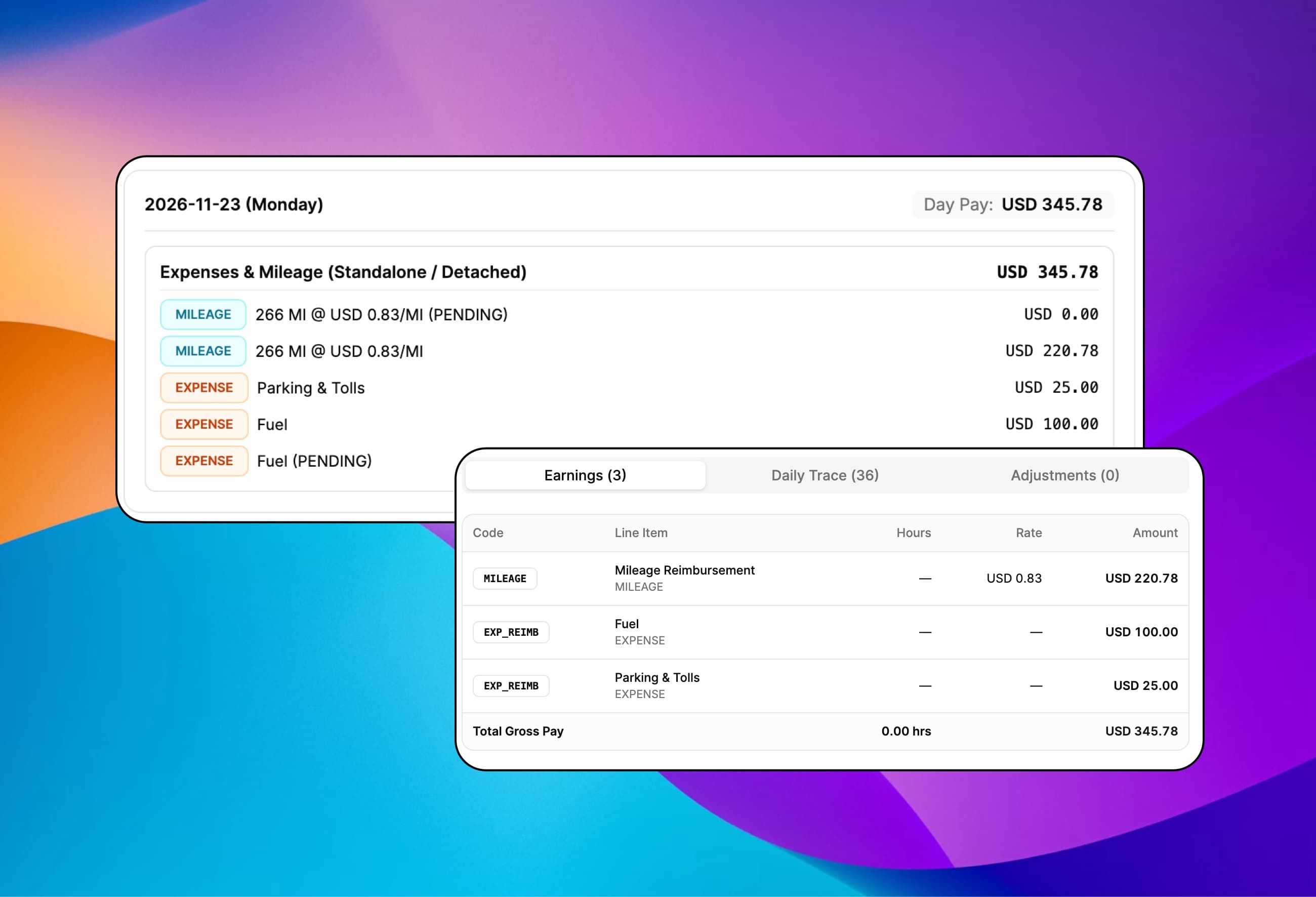
Track mileage, receipts & shift pay in one payroll run
Instead of chasing odometer spreadsheets and paper receipts every Monday, ClockIt enforces per-site miles/km rates, annual tiered step-downs (HMRC, CRA, ATO), FAVR vehicle allowances and expense caps automatically — then exports clean CSVs for QuickBooks, ADP, Gusto, Rippling or Deel.
- Submit mileage & receipts from Web, iOS/Android Mobile & Kiosk
- Multiple vehicle types & Fixed + Variable (FAVR) plans
- Optional per-run opt-in to Payroll Run with custom earning codes
- Includes shift differentials, holiday pay & overtime at $2.99/user/mo